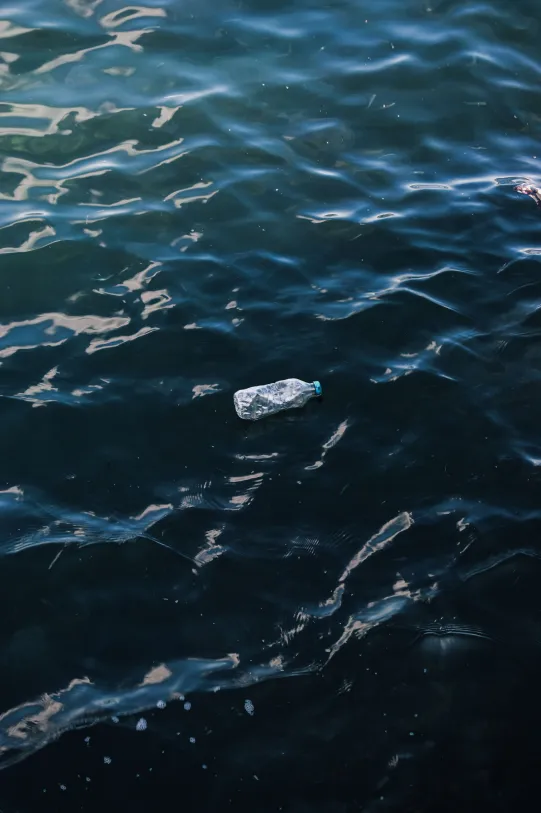
Polyester is one of the most transformative materials ever created. It’s strong, versatile, and long-lasting; qualities that have made it essential across industries. But the very durability that makes polyester useful also makes it one of the most persistent pollutants on Earth.
Microplastic pollution has become one of the most pervasive environmental challenges of our time, and synthetic textiles are among its largest contributors. Once shed, its fibers remain for centuries, accumulating in oceans, soils, and living organisms.
We can no longer accept that plastic fibers should last forever — which is why we have adopted CiCLO® technology to change that.
We are using CiCLO®-enhanced materials that are embedded with patented, microbe-accessible sites directly into the polymer structure which allows polyester to behave more like natural fibers at the end of its life. When CiCLO®-enhanced fibers enter the environment, naturally occurring microorganisms recognize and break them down, converting them into CO₂, water, and biomass. Not microplastic.
This process is natural, permanent, and verified by independent laboratories under globally recognized ASTM standards.
The microplastics problem
The scale of the problem is staggering.
In 2025, global plastic waste is projected to reach 460 million tons annually, including 51 trillion microplastic particles already circulating in our oceans, soils, and air.
Textiles are a major source of this pollution. Over 70 million tonnes of polyester are produced each year, accounting for roughly 60% of all global textile fibers. Every wash, every gust of wind, every fray releases tiny synthetic fibers into the environment, so small they evade filtration systems and accumulate across the planet.
Unlike natural fibers, conventional polyester does not biodegrade. Once released, it remains indefinitely. Fragmenting, spreading, and infiltrating ecosystems.
This pollution is no longer invisible. Microplastics are not just waste. They are disrupting marine ecosystems, entering food chains, and threatening biodiversity.
These microfibers have been found in Arctic snow, deep-sea sediments, drinking water, and even human lungs. Every year, the amount of synthetic fibers entering the ocean alone is estimated to equal the weight of 50 billion plastic bottles.
We believe that continuing to produce textiles that never return to nature is no longer viable.
A nature-based technological solution
Through a patented process, CiCLO® is molecularly embedded into polyester during manufacturing. This additive creates countless biodegradable sites throughout the polymer matrix. When CiCLO®-enhanced fibers enter environments such as soil, seawater, or compost, these sites act as nutrient sources for naturally occurring microbes.
The result: microbes are able to digest and mineralize the polyester at rates similar to natural fibers like wool or cotton. The process returns the carbon from the fibers to nature’s cycle, converting it into elements like CO₂, water, and biomass.
Proven science. Real results.
The efficacy of CiCLO® technology is supported by rigorous, independent testing using internationally recognized ASTM standards:
- Marine Biodegradation (ASTM D6691-17)
In natural seawater, CiCLO® fibers achieved 94% biodegradation after 1,362 days, compared to 5% for untreated polyester. - Soil Biodegradation (ASTM D5988)
In soil environments, CiCLO® fibers biodegraded by 91% after 1,171 days, while untreated polyester remained unchanged. - Certified Safe Chemistry
CiCLO® chemistry is OEKO-TEX® ECO PASSPORT certified, REACH compliant, and verified non-toxic to marine and plant ecosystems.
This ensures full compliance with the highest global standards for ecological safety and responsible manufacturing.
These findings confirm that CiCLO® doesn’t just degrade - it biodegrades naturally, through the same microbial processes that return organic matter to the earth.
Designed for integration, not disruption
One of CiCLO®’s most significant advantages is its compatibility with existing textile infrastructure. It integrates seamlessly into current polyester and nylon production systems, including recycled polymers (rPET).
This makes it possible to combine circularity with biodegradability, addressing one of recycling’s biggest limitations: microplastic shedding. Even recycled fibers can release pollution when washed or worn. CiCLO® ensures that when these fibers inevitably enter the environment, they do not persist indefinitely.
Importantly, CiCLO® maintains the performance, strength, and recyclability of conventional polyester. The technology does not alter the feel, printability, or weather resistance of the material, making it a direct, scalable solution for responsible production today. Not a distant innovation.
Who’s behind CiCLO®
The innovation is the result of Intrinsic Advanced Materials (IAM), a joint venture between Intrinsic Textiles Group (USA) and Parkdale Advanced Materials, a division of Parkdale Inc.
IAM brings together a multidisciplinary team of scientists, engineers, and textile industry experts who share a vision for a circular, bio-assimilative future. Their work has been recognized globally for leadership in addressing microfiber pollution, including awards from USA Today and the Global Conscious Brand Awards.
We only work with licensed partners of IAM, such as Georg+Otto Friedrich in Gemany.
Our perspective
The failure of global policy to address plastic pollution only reinforces one truth: industry must lead where politics cannot. The path forward depends on tangible, science-based action and we are determined to be part of that change.
And we know that technology alone is not enough. Responsibility requires continual evolution.
We see CiCLO® as a beginning, not a finish line. It is one of the most advanced tools available to address microfiber pollution today, and we are committed to using it to set a new benchmark for sustainable polyester in our industry.
Explore Our Latest Insights